Sunday, 14 June 2009

OCA Landscape: Project 15

This project has to be taken over the year it is reckoned you will take to do this course. This is the same location I used for my One Acre Assignment so I visieted it frequently and it is pretty close to home.

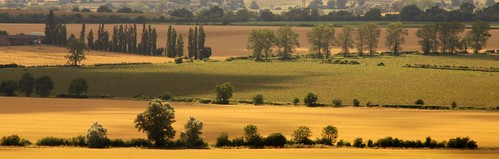
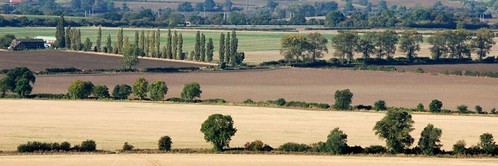
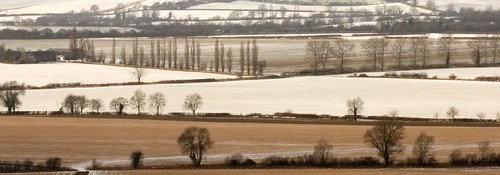
The same view taken over four seasons:

From 'The Clappers'
Spring (April)

Panorama - July
Summer (July)

Panorama - October
Autumn (October)

Panorama - January
Winter (January)


The autumn scene is not what you expect as it doesn't show the normal autumnal colours. However I was lucky as we had a good sprinkle of snow.

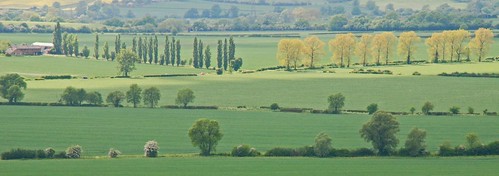
View towards Harlington, from Sharpenhoe Clappers, Bedfordshire.

Monday, 8 June 2009

Windows and Mirrors

I have been reading from various sources, mainly on line about an exhibition at MOMA, New York (1978) called "Mirrors and Window: American Photography since 1960". The accompaniying catalogue contains an essay on this theme by the then director of photography John Szarkowski.
Joe Cornish, on his web page, says he found the essay hard work and at this moment in time I have no intention of reading it, however the essence of what he is saying interests me.

"This arrangement is designed to illustrate a critical thesis which I hope may offer a simple and useful perspective on the bewildering variety of technical, aesthetic, functional, and political philosophies that characterise contemporary photography's colloquium. This thesis suggests that there is a fundamental dichotomy in contemporary photography between those who think of photography as a means of self-expression and those who think of it as a method of exploration."
To quote Cornish summarizing "Some photographers are more interested in themselves, and some are more interested in their subject matter" You can read more of Cornish's article here
So some photographs are windows onto the world, a description, a straight representation. Traditional landscape, documentary and portrait photography could be seen as photographs as windows.
Photographs as mirrors however, according to Szarkowski are a reflection of the photographer's self-expression. Cornish seems to regard this idea in a disparaging way suggesting self-obsessed.
indulgent artists.
John Blakemore, in his Black and White Photography Workshop, however sees the photograph as a 'mirror' as a means of self-expression for the photographer with the photograph acting as a metaphor. He suggest the photograph then is concerned not with information but with suggestion. Perhaps here could begin a debate about the photographer as artist. These two could serve as good examples. Joe Cornish's landscapes are beautiful aesthetic experiences, many abstracted details of rock and natural formations. John Blakemore's photographs however are more obviously a product of his creativity. He talks of previsualizing an image, and then how to achieve this through studio and darkroom techniques. So is Blakemore more of the artist than photographer?
In conclusion Szarkowski acknowledges that no photograph is purely 'mirror' or 'window' but on a continuum between the two. Perhaps there is a similar artistic spectrum on which we can place photographers - a debate for another time.

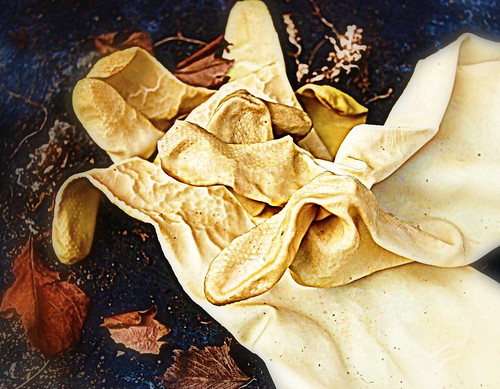
Here is my own contribution,from my greenhouse series:
Last Year's Gloves

gloves

Friday, 5 June 2009

Abstract or not?

I have been reading a lot of definitions of abstract photography to try to clarify my own thinking. It seems to me that macro images are often described as being abstract when they are just close-ups or detail. Here are some defininitons of abstract I have culled from many sources ;-
  • Abstract (adjective) existing in the mind only. Having no reference to material objects of specific examples. Not concrete.
  • Abstract (noun) essence of the whole
  • Abstract (verb) to take away. To remove from reality.
Perhaps the definition is less easy to apply to photography than other art forms. We know when a painting is non-representative and may be a total result of the artist's imagination, but in photography, the viewer knows that the photographer started with an object or a view of the natural world which has been abstracted. Very often the object is still recognizable but the subject has become secondary to other considerations such as shape, form, colour.
Before taking the Open College of Arts photography course these questions would not have mattered to me, but now I want to develop a language to talk about my photography.

Here are two of my photographs which illustrate what I have been talking about.
Abstract or macro?


beads
Beads


glasshouse 5
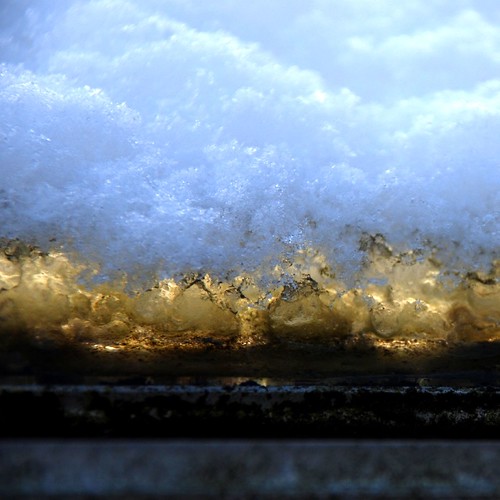
Ice and Fire

Beads is a macro shot taken infront of blue and red cellophane taped on a window.

Ice and Fire is snow on a greenhouse roof, shot into the morning sun.

Thursday, 4 June 2009

Some thoughts on Fay Godwin

Having finished my written assignment on Fay Godwin I have to complete my final assignment with photographs taken in her style. The photographs of hers which have attracted my attentions are the colour pictures she had to publish herself called Glassworks and Secret Lives. The book is out of print but I managed to get a small signed paperback after a short search on google. The hardback versions are over £100. There are a good selection from this collections in her book Landmarks which is easily available.
The images in this book are such a departure from her usual black and white landscapes that no one wanted to publish it, which is why it was done privately, however I love the images. This is the only one I could find on-line which links to an interview with Fay for BBC's Woman's Hour, here.


It is these images, many of which which may be described as abstract which have attracted me and inspired me in making her my choice as my chosen subject and I hope to make last assignment in the style of these colour photographs.


Wednesday, 27 May 2009

OCA Photography 2: Landscape - Assignment 3: Ten photographs with a common theme

Tracks and Pathways
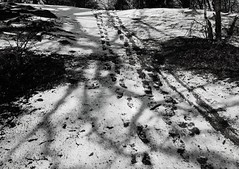
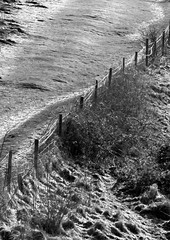
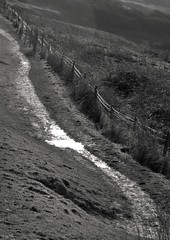
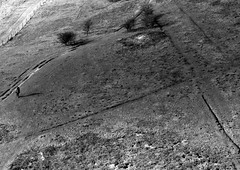
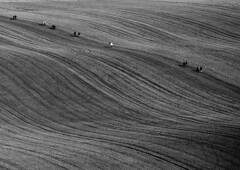
For this Assignment students have to choose their own linking theme. As I finished the previous assignment I was pretty certain what mine would be. For most people in urban Britain the countryside is accessed through the network of public pathways that cause so much controversy between rambles and landowners. Although I did not want to enter this debate I did want to record the way we use the countryside and leave our mark in the form of tracks and pathways. I was also researching which photographer to study for my critical review and was drawn to Fay Godwin. More about her later. She photographed the British countryside in black and white and recorded human interaction and influence on the landscape in everyway. So, influenced by her work, and wanting a different challenge I decided to make this project in black and white. I had photographs taken over several months as some were contenders for the 1 Acre assignment. In making my selection the graphic quality of the composition was a strong influence. Overall I was pleased with the selection, and it is always interesting how my tutor seemed favour some of the shots I liked the least. This was the first assignment I shot in RAW format. I worked on most of the images in Photoshop Elements cropping, adjusting levels and using dodge and burn. Here are the photographs, all linked to my flickr postings.

Tracks and pathways 1
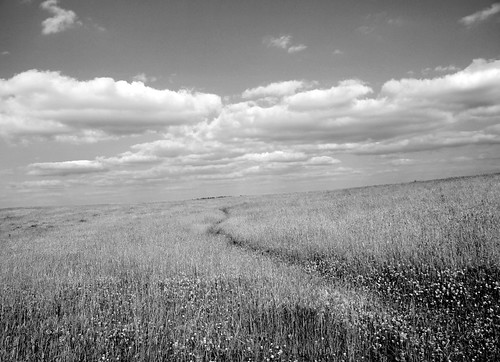
The Hay Meadow

Tracks and pathways 2
The Curved Path

Tracks and pathways 5
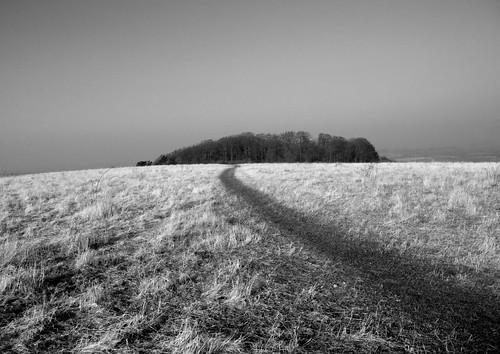
Over the Hill

just a sprinkle...
Footprints in the Snow

diagonal path
Fence and Path

puddled path
Puddled Path

lone walker - final edit
The Lone Walker

Tracks and pathways 3 (edited)
The Undulating Field

Sunday, 17 May 2009

OCA Photography 2: Landscape Assignment 2 - One Acre

It was easy for me to choose the location of my one acre for this assignment. Sharpenhoe Clappers is a ten minute drive away from Luton but a wonderful haven of peace and tranquility. The Clappers is a spur of land overlooking the fields of Bedfordshire and part of the Chiltern trail. It is owned by the National Trust and consists of meadow and a beech wood. My chosen area is mainly within the wooded area. Although a popular site with locals and hikers following the Chilterns it always seems peaceful. Surrounded on three sides by steep slopes it has a sense of isolation from it's surroundings, rising above everyday life. On still days voices and traffic noises carry from the village at the foot of the hill giving a further sensation of detatchment. It was this atmosphere I wanted to convey in my photographs. I have uploaded them in three groups as I find it easier to manage that way.

One Acre - Sharpenhoe Clappers (Set one)
1. The first picture is taken from the footpath leading to the wooded 'nose' of the spur of land. I wanted to show the flora along the path and the view across the fields immediately giving the viewer a sense of elevation.
2. Here I scrambled up the bank to look down on the path as it skirted the trees. This gave me a diagonal composition. This picture has a rather yellowy warm cast. Since my tutor's feedback on this project I have been shooting in RAW, which would have enabled me to deal with the tone more easily. It is good to look back and see how you could now make an improved shot.
3. Here the beech trees are silhouetted against the fields. I was pleased with the feeling of enclosure, of being in the woods looking down on the rest of the world. Once again RAW would have given me more control over the exposure.
4. This is one of my favourite views. Before harvest and the wheat fields are golden. It was late afternoon and there is an un-natural pink cast in the sky - next time!
5. I wanted to avoid a conventional sunset, although they are spectacular from the top, it does entail walking back to the carpark through a wooded path in the dark. So here half way back to the carpark I caught the low sun between the trees. As the slope falls away the sun catches the tops of the trees further down the slope before it rises up again on the Chiltern ridge.
1.
1 acre -  view
2.
1 acre - path
3.
1 acre - silhouette
4.
July
5.
golden evening

The rest of the assignment is over the previous two blogs
OCA Photography 2: Landscape Assignment 2 - One Acre

One Acre - Sharpenhoe Clappers (Set 2)
With this group of pictures, the aim was to depict different aspects of the interior of the chosen acre.
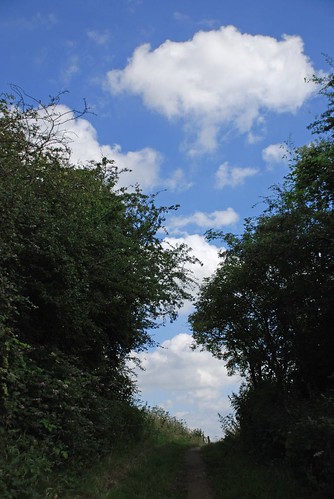
  1. This path is bordered by a high hedge and one emerges from the shady path into the open sunshine. I took several shots and waited some time for the right cloud formation. This one wasn't quite centred on the gap, but it was very windy and the clouds were moving and changing shape fast.
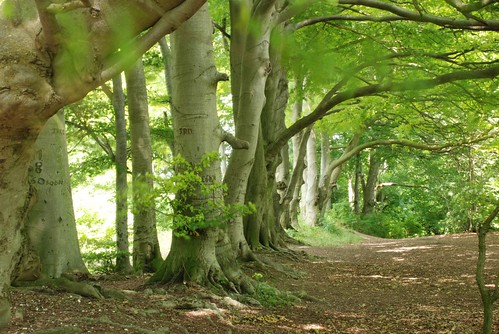
  2. In contrast this broad path is alongside a line of old beech trees, the high canopy at the edge of the trees let in the sun.
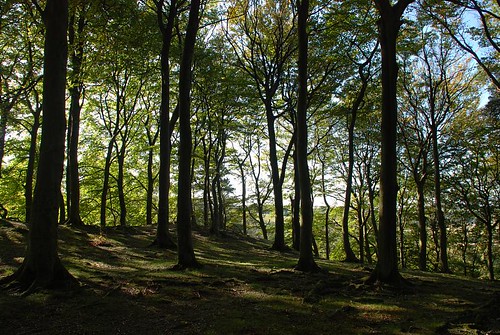
  3. Here there are much younger beech trees growing close which give a gloomy feel to the centre.
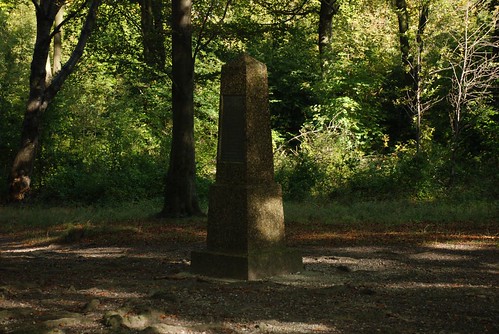
  4. The Clappers was left to the National Trust by a family in remembrance of brothers lost in the first world war. This rather bleak obelisk commemorates the gift.
1.
1 acre - cloud
2.
1 acre - beech trees

3.
Young beeches
4.
1 acre - monument